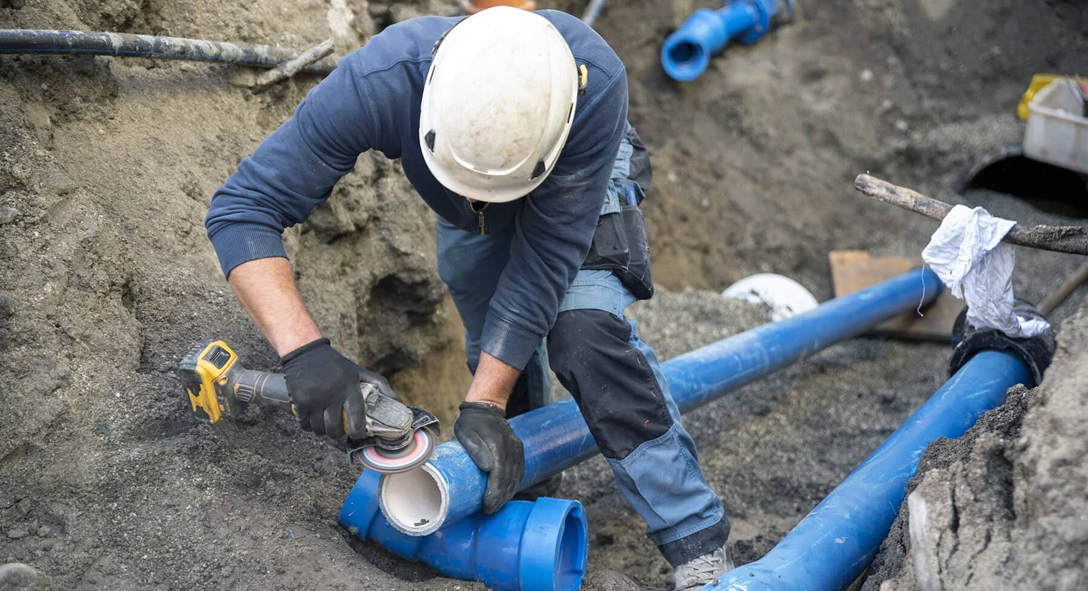
Edmonds has some of the most desirable real estate on the Puget Sound, and a large portion of that housing stock was built between the 1950s and 1970s. What that means, practically, is that a significant number of Edmonds properties still have the original sewer lateral installed when the house was built , pipes that are now 50 to 70 years old and operating well past the service life of the materials they are made from.
The American Society of Civil Engineers documented in its 2021 Infrastructure Report Card that wastewater pipes across the U.S. average 45 years old, with typical lifespans ranging from 50 to 100 years depending on material and conditions. Clay tile and Orangeburg pipe, the two most common lateral materials in mid-century Pacific Northwest construction, sit at the shorter end of that range. Many specimens in Edmonds have already exceeded it.
A sewer camera inspection on a 1965 Edmonds home is not a precaution. It is a reasonable response to a known statistical reality. This article covers how aging sewer pipes affect Edmonds homes across four dimensions: physical failure modes, health and safety risks, repair costs, and property value.
In this article, you will learn about:
- How clay tile, Orangeburg, and cast iron laterals fail over time
- The health and safety risks an aging lateral creates for your household
- What repair and replacement costs look like in this market
- How a failing or undocumented lateral affects property value in Edmonds
- What proactive steps protect both your home and its value
Keep reading to understand what a 60-year-old lateral is doing beneath your property, and what options are available before it forces your hand.
How older sewer laterals fail in Edmonds
Sewer lateral failure is not a single event. It unfolds over years, driven by the properties of the pipe material, local soil conditions, and root systems that have been tracking moisture since the lateral was installed. Three pipe materials dominate the aging lateral picture in Edmonds: clay tile, Orangeburg, and cast iron. Each has a distinct failure signature.
Understanding which material is in your lateral, and what failure mode applies to it, is the starting point for any realistic maintenance or repair decision.
Clay tile pipe and joint separation
Clay tile was the standard lateral material for Pacific Northwest residential construction from the post-war period through the early 1970s. It was installed in short sections joined at spigot connections sealed with sand-pack mortar or rubber gaskets. The pipe material itself is durable. The joints are the vulnerability.
Over decades of seasonal soil movement and sustained root pressure, those joints separate. The gaps allow fine root hairs to enter, and once inside, those roots expand into masses that catch debris and narrow flow. Signs that clay tile joints are failing include:
- Recurring slow drains that clear with snaking and return within months
- Gurgling from floor drains when the washing machine runs
- Sewer odors from basement drains with no clear interior source
- Root masses visible in the pipe during a camera inspection
A clay lateral with established root intrusion can move from manageable to structurally compromised within a single growing season. The tree roots and sewer problem in Edmonds is not unique to one neighborhood — it is consistent across every established area where mature maples, Douglas firs, and ornamental trees sit close to original laterals.
Orangeburg pipe and internal deformation
Orangeburg pipe was manufactured from compressed wood fiber and tar, used in residential construction from the mid-1940s through the late 1950s. It was never intended to be a 70-year pipe. The failure mode is internal deformation: Orangeburg absorbs moisture over decades, softening and losing its circular cross-section. The bore transitions from round to ovalized to partially collapsed, restricting flow without cracking or fracturing.
This failure mode is particularly difficult to detect from surface symptoms alone, because flow restriction from deformation looks identical to restriction from a grease blockage. The only way to distinguish between a deformed Orangeburg pipe and a cleaning candidate is with a camera inside the line. Homes built in Edmonds between 1947 and 1958 have a meaningful probability of Orangeburg in their lateral.
Cast iron and interior scale buildup
Cast iron laterals, used in residential construction from the 1950s through the 1970s, corrode from the inside out over decades of exposure to the acidic wastewater environment. The corrosion produces scale deposits on the interior wall: rough, irregular buildups that narrow the effective bore and catch grease and debris passing through.
A cast iron lateral in service for 60 years may be carrying a flow cross-section significantly smaller than its nominal diameter. The scale buildup that produces this condition develops gradually and produces symptoms that are easy to misread:
- Slow drainage that worsens incrementally over months
- Periodic blockages that clear with snaking and return more quickly each cycle
- Kitchen drain backups that seem disproportionate to what went down it
- Increasing frequency of service calls for what appears to be the same drain problem
A sewer line inspection on a cast iron lateral in a home older than 40 years often reveals an interior that looks quite different from what the pipe’s nominal dimensions suggest.
Health and safety risks an aging lateral creates
Most homeowners think of a failing sewer lateral primarily as a plumbing problem. It is that, but it is also a health and safety issue that affects the household directly. The risks do not announce themselves loudly in the early stages, which is part of why they go unaddressed.
A lateral that has developed cracks, joint offsets, or partial collapses is releasing wastewater and sewer gas into surrounding soil, potentially into crawlspaces, and in the worst cases into the basement or lower floor of the home.
Sewer gas exposure from cracked laterals
Sewer gas, the hydrogen sulfide and methane mixture produced by decomposing organic waste, should be entirely contained within the drain and vent system. When a lateral develops cracks, gas migrates through soil voids and into the structure through foundation gaps, floor drain connections, and crawlspace openings.
The Illinois Department of Public Health documents that hydrogen sulfide at lower chronic exposure levels can cause eye irritation, headache, and fatigue, and that at higher concentrations it overwhelms the sense of smell, removing the warning that it is still present. Symptoms that point toward sewer gas from a cracked lateral rather than a dry trap include:
- Persistent odor throughout the lower floor that does not correlate with fixture use
- Smell strongest in the morning when temperature differentials push soil gas through foundation gaps
- Odor that fades during the day but returns consistently overnight
- Household members experiencing unexplained headaches or eye irritation with no other source
A home with a failing lateral leaking gas through the crawlspace is an ongoing exposure condition, not a nuisance.
Wastewater contamination and secondary damage
A lateral leaking wastewater into surrounding soil introduces pathogens, bacteria, and organic waste into the immediate foundation environment. Over time, that contamination creates conditions for moisture intrusion, wood rot in crawlspace framing, and a persistent odor that cannot be resolved with surface cleaning. The longer the leak continues, the more the remediation required alongside the pipe repair expands.
This is one of the core arguments for catching a failing lateral early. The pipe repair scope is similar whether a crack is found at six months or at three years. The secondary damage addressed alongside it is not.
The sewage backup as a Category 3 hazard
A full sewer backup, where wastewater reverses into the home through floor drains, toilets, or showers, is a Category 3 water intrusion event — the highest hazard classification in professional remediation standards. The EPA notes that sanitary sewer overflows carry bacteria, viruses, protozoa, helminths, and inhaled molds and fungi, creating significant public health risks at the point of exposure.
Cleanup after a sewage backup requires professional remediation. Porous materials that contact sewage, including drywall, insulation, carpet, and wood subflooring, are typically classified as non-salvageable. The remediation cost of a basement backup routinely exceeds the lateral repair cost that would have prevented it.
What aging sewer pipe repair and replacement costs look like
The financial reality of an aging lateral in Edmonds covers a wide range depending on the condition of the pipe, the repair method, the depth and route of the lateral, and what sits above it. Understanding that range before a crisis develops is considerably more useful than learning it during one.
The variables that drive cost are well understood, and a camera inspection is the tool that places a specific lateral on the cost spectrum with precision.
Early intervention versus late intervention
The clearest financial argument for proactive maintenance is the gap between what a problem costs when caught early versus when it is caught after failure. The contrast is significant:
- Root intrusion cleared with hydro jetting before structural damage: a few hundred to a few thousand dollars
- Root intrusion left to cause pipe wall failure requiring excavation: $5,000 to $15,000+, plus restoration
- A spot repair at a localized crack while surrounding pipe is intact: targeted and affordable
- The same localized problem allowed to spread until full lateral replacement is needed: a substantially larger project
- Camera inspection cost: the same regardless of when it is scheduled
What changes with timing is not the inspection cost. It is which repair category the findings fall into.
Trenchless repair versus traditional excavation
For laterals that require structural repair rather than clearing, the method selection has a major cost impact. Trenchless CIPP lining and pipe bursting require only two small access pits, eliminating the restoration costs that traditional excavation triggers. In Edmonds, where many homes have mature landscaping, paved driveways, and finished hardscape, the restoration component of a traditional excavation can add thousands to the base repair price.
Trenchless methods require a pipe with sufficient remaining structural integrity to support a liner. A fully collapsed section cannot be lined. A deformed Orangeburg pipe that has lost its round bore may not be a lining candidate. This is why the camera inspection precedes any repair method discussion — the footage determines which options are on the table.
What insurance does and does not cover
Standard homeowners insurance policies in Washington generally exclude sewer lateral repairs, treating them as maintenance rather than sudden covered perils. Root intrusion, corrosion, and age-related failure are almost never covered under a standard policy.
A sewage backup endorsement, available as an add-on rider from most insurers, typically covers cleanup costs from a backup event but not the pipe repair itself. Homeowners who discover a failing lateral and expect their policy to cover the repair usually find the cost lands entirely on them. Confirming this with your insurer before a failure occurs is worth 15 minutes.
How a failing or undocumented lateral affects Edmonds property value
The Edmonds market is competitive and buyer sophistication is high. Buyers working with experienced agents in this market increasingly request sewer scope inspections as standard due diligence, and what those scopes find — or what the absence of one leaves unresolved — has a direct effect on transaction outcomes.
An aging, uninspected lateral is not a neutral factor in an Edmonds home sale. It is an unknown risk that buyers price into offers or use as leverage in repair negotiations.
How buyers treat unknown lateral condition
A buyer who has not scoped a 1965 Edmonds home faces a straightforward calculus. The lateral is likely original, likely clay tile or Orangeburg, and likely in a condition ranging from functional to failing. Without documentation, the buyer cannot know which end of that spectrum applies. Most experienced Eastside buyers respond to that uncertainty in one of three ways:
- Requesting a seller-paid scope before removing contingencies
- Factoring a contingency repair budget into their offer price
- Walking away if the seller declines to provide any sewer documentation
A pre-listing scope removes that calculation entirely. A clean result is a documented asset. A disclosed and repaired issue converts a buyer liability into a selling point. Homeowners in Edmonds and throughout Snohomish County who have sewer documentation consistently move through transactions with less friction than those who do not.
The negotiating impact of a problem found during due diligence
A lateral problem discovered by the buyer’s inspector after an offer is accepted is a materially different situation from a problem disclosed upfront. The buyer now holds a documented repair estimate and the leverage that comes with it. The negotiation that follows typically produces one of these outcomes:
- A price reduction equal to or exceeding the repair cost estimate
- A seller-funded repair credit at closing
- A combination of both, along with extended due diligence timelines
The price reduction demanded for an unresolved lateral condition is often higher than the actual repair cost, because it also prices in buyer risk, scheduling uncertainty, and the inconvenience of managing a repair after closing. A seller who repairs the lateral before listing typically recoups more of that cost in final sale price than one who takes a dollar-for-dollar credit at closing.
What a pre-listing inspection delivers
A sewer inspection for home buyers framing applies equally from the seller’s side. A pre-listing inspection delivers three practical outcomes:
- It identifies any conditions that would generate a buyer repair request
- It gives the seller time and choice in how to respond before listing
- It produces documentation that reduces buyer uncertainty even when findings are modest
For a home in Edmonds with a 60-year-old lateral beneath mature trees, a pre-listing inspection is not optional. It is the most efficient way to manage a known risk variable before it surfaces in negotiation.
Conclusion
Aging sewer laterals in Edmonds are a physical reality for a large share of the city’s housing stock, and the consequences of ignoring them are predictable. A pipe installed in 1964 has been in service for more than 60 years. What it looks like today, and how much functional life remains, is a question a camera can answer in a single visit.
The homeowners who manage this risk well are the ones who get the information before they need it. A lateral found to be in good condition is a documented asset. Early root intrusion is a maintenance item, not a crisis. A failing pipe is a repair project that costs far less when addressed before it becomes an emergency replacement.
When you are ready to find out what your Edmonds lateral is actually doing, Seattle Select Sewers is ready to show you.