
Somewhere between finding a house you love and actually closing on it, someone is going to mention a sewer scope. Maybe it is your agent, maybe it is the home inspector, maybe it is a friend who learned the hard way. Either way, the question that follows is almost always the same one: what does this actually cost, and is it worth it.
The honest answer is that the price of a sewer scope inspection is small compared to what it protects you from. A standard home inspection does not look underground. The pipe running from your house to the street is invisible to almost every other inspection you will pay for during a real estate transaction, and it is also one of the most expensive things that can go wrong with an older home.
This guide breaks down what actually drives the cost of a sewer scope inspection, why the price varies from one property to the next, and why timing the inspection right matters more than chasing the lowest quote.
In this article, you will learn about:
- What a sewer scope inspection actually involves
- The factors that drive cost up or down
- Why Seattle homes carry unique inspection risk
- How to use the inspection results once you have them
Keep reading to understand exactly what you are paying for and how to make sure the money you spend on an inspection actually protects you at closing.
What a sewer scope inspection actually covers
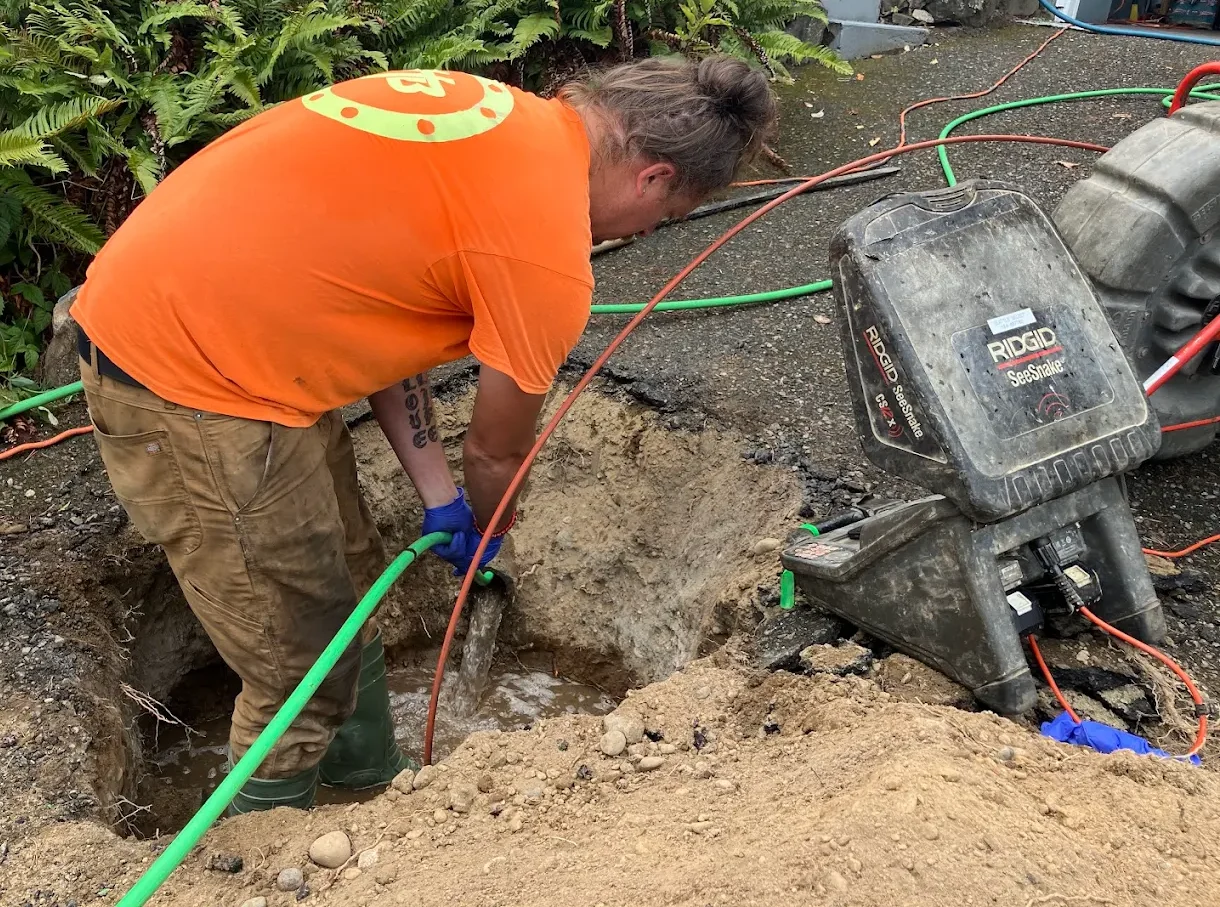
A sewer scope inspection is a camera run through your side sewer, the private pipe that carries wastewater from your house out to the public main. A trained technician feeds a flexible camera into a cleanout or an access point and records what the pipe looks like from the inside.
This is different from a standard home inspection in an important way. General home inspectors look at visible, accessible systems: the roof, the foundation, the electrical panel, the plumbing fixtures you can see. Nothing about a standard inspection requires anyone to look underground.
- The camera identifies cracks, breaks, and collapsed sections along the pipe
- It shows root intrusion at joints and connection points
- It reveals bellies, meaning sections where the pipe has sagged and collects standing water
- It documents the pipe material, which tells you roughly how much life the line has left
Understanding what the camera is actually looking for helps explain why the inspection matters so much for older homes specifically. Once you know what the camera can find, the next logical question is what determines how much the service costs.
Why this inspection sits outside the standard scope
Professional home inspection standards specifically exclude underground sewer lines from a general inspection. The American Society of Home Inspectors lists underground items among the things a standard inspector is not required to inspect, which is exactly why a sewer scope has to be requested and paid for separately.
This exclusion is not an oversight. Inspecting a buried pipe requires specialized camera equipment that a general home inspector does not carry, and the liability of certifying an underground system nobody can see without that equipment is a separate professional line altogether.
- Confirm with your inspector or agent whether a sewer scope is included in your inspection package
- If it is not included, treat it as its own line item to schedule separately
- Ask whether the same company can bundle the scope with a general inspection to save a trip
Knowing this gap exists before you are deep into a transaction saves you from assuming the sewer line was checked when it never was.
What the camera cannot tell you
A sewer scope is thorough, but it has limits worth understanding before you rely on it completely. The camera shows the interior condition of the pipe at the moment of inspection, not a guarantee about what happens next.
A pipe that looks clean today can still fail within a few years if it is close to the end of its material lifespan. The scope is a snapshot, and a good technician will tell you plainly when a line looks structurally sound but old enough to warrant a closer look at replacement timing.
- The inspection cannot predict exactly when a marginal pipe will fail
- It cannot see conditions outside the pipe itself, such as soil movement around it
- It generally covers the accessible side sewer, not necessarily the public main
- A clean scope today does not exempt a homeowner from future maintenance
Treating the report as a point-in-time health check, rather than a permanent clearance, is the right way to use the information it gives you.
How a cleanout makes the whole process easier
Every side sewer should have a cleanout, an accessible pipe fitting that gives a technician direct entry to run the camera without pulling a fixture or drilling anywhere. Homes that already have one make the entire scope faster and cheaper.
Homes without an accessible cleanout are not disqualified from a scope, but the technician has to find another way in, usually through a toilet or a roof vent, which adds time and sometimes a small additional charge.
- A visible exterior cleanout, usually a capped pipe near the foundation, is the ideal access point
- Older homes sometimes have a cleanout that has been buried, paved over, or landscaped around over the years
- Installing a proper cleanout if one does not exist can pay for itself on every future inspection
- A technician can usually identify during the initial call whether access will be straightforward or will need extra time
If you own the home long-term rather than just passing through a real estate transaction, adding a cleanout is a small investment that makes every future inspection or service call faster.
What actually drives the cost up or down
Sewer scope pricing is not one flat number, and quotes vary for real reasons tied to the property itself. A straightforward scope through an accessible cleanout on a newer home looks nothing like a scope on an older property with no easy access point.
The biggest cost drivers tend to be access, length, and complexity, not the base service itself. Understanding these factors helps you evaluate a quote instead of just comparing dollar figures across companies.
- Access matters most. A property with an existing exterior cleanout is faster and cheaper to scope than one where the technician has to pull a toilet or find another entry point.
- Pipe length and layout affect time on site. A longer run, or one with multiple bends, takes longer to fully camera than a short, straight lateral.
- Older homes without a visible cleanout sometimes require locating equipment to trace the line before the camera even goes in.
- Some companies bundle a locate service, which pinpoints the exact depth and path of the pipe, and that adds to the base scope price.
None of these factors are hidden fees. They reflect genuine differences in the work required, and a company that explains them clearly before quoting is usually one worth trusting with the job.
When bundling saves money
Many sewer scope providers offer a lower rate when the service is scheduled alongside a general home inspection on the same visit. The logic is straightforward: one trip to the property covers two services, which reduces overhead for the company and often gets passed along as savings.
If you are already scheduling a home inspection, it is worth asking directly whether a sewer scope add-on is available and what the combined rate looks like compared to booking each service separately.
- Ask your general home inspector if they offer sewer scopes as an add-on
- If not, ask whether they have a preferred sewer specialist they coordinate with regularly
- Compare the combined quote against booking a standalone inspection appointment after the fact
Bundling is not always the cheaper path for every property, but it is worth checking before assuming a separate appointment is your only option.
Emergency versus scheduled inspections
A scope requested with plenty of lead time, during normal business hours, typically costs less than one requested on short notice or during a real estate closing window with days to spare. Urgency changes scheduling flexibility, and that shows up in price.
Homebuyers under contract deadlines sometimes end up paying a premium simply because the inspection has to happen fast. Planning ahead, even by a few extra days, gives you more room to shop and schedule on your own terms.
- A scheduled, non-urgent scope generally has more provider options and better pricing
- Same-week or same-day requests during a closing window often carry a premium, similar to the urgency that drives up cost during an actual sewer backup
- Requesting the scope as early as possible in a transaction timeline protects your negotiating position
- A provider who can turn around a report quickly is valuable, but that speed sometimes costs more
If your timeline allows it, requesting the scope the moment your offer is accepted, rather than waiting until the final days of the inspection period, gives you the most flexibility on both price and provider choice.
What a quote should actually include
A clear, trustworthy quote spells out exactly what is covered before the technician ever shows up. Vague pricing with a long list of “may apply” add-ons tends to lead to surprises at the invoice stage.
Ask specifically whether the quote includes the written report, the video footage, and any locating work if the cleanout is hard to find. A company confident in its pricing should be able to answer these questions on the phone without hesitation.
- Confirm whether the quote is a flat rate or subject to change based on access difficulty
- Ask whether the written report and video are both included or sold separately
- Clarify whether a repair estimate, if something is found, comes at an additional cost
- Get the quote in writing before the appointment, not verbally on the day of service
A company that answers these questions clearly before scheduling is usually the same company that delivers a clean, professional report afterward.
Why Seattle homes carry unique inspection risk
Seattle’s housing stock skews older than a lot of other West Coast markets, and that history is exactly why sewer scopes matter so much here specifically. Homes built before PVC became standard often still have their original side sewer material in the ground.
Clay, cast iron, and concrete pipes were the norm for decades, and none of them were designed with a service life that stretches indefinitely. A pipe that has quietly done its job for fifty or sixty years can still be near the end of that job without any visible sign at street level.
- Older Seattle neighborhoods commonly have clay or cast iron side sewers still in service
- Mature street trees throughout the city mean root intrusion is a persistent, ongoing risk
- A property’s age alone is often the single best predictor of whether a scope will find something
- Homes that have never been scoped carry more uncertainty than homes with a documented inspection history
None of this means every older home has a failing sewer line. It does mean the odds of finding something worth knowing about go up significantly with age, which is exactly the situation a scope is designed to resolve before it becomes expensive.
The disclosure angle sellers should know
Washington law requires most residential sellers to complete a Seller Disclosure Statement, commonly called Form 17, covering known material facts about a property, including the sewer or septic system. Under RCW 64.06, buyers who receive a disclosure statement generally have three business days to reconsider the purchase agreement, which underscores how seriously state law treats accurate answers on that form.
A seller who has already had a sewer scope done, and discloses a clean result, gives buyers real confidence and can smooth the entire negotiation. A seller who has never scoped the line and has no idea what condition it is in is disclosing exactly that: unknown condition, which understandably makes buyers want to check the line for themselves.
- Sellers with a recent clean scope report can disclose it proactively as a selling point
- Sellers who are unsure of their line’s condition should expect buyers to request their own scope
- Buyers should never rely solely on a seller’s disclosure without independent verification when the stakes are this high
Getting ahead of this conversation, whichever side of the transaction you are on, tends to produce smoother closings than leaving it as an open question until late in the process.
Properties with septic instead of sewer
Not every property inside the greater Seattle area is on the public sewer system, and the inspection requirements diverge sharply for septic properties. King County requires an operation and performance monitoring report completed within the six months before closing for most on-site septic systems, a separate and more formal process than a standard sewer scope.
If your property or the one you are buying uses a septic system rather than a public sewer connection, the entire framework covered in this guide shifts. Confirm which system applies to the property early, since the required documentation and inspection timing are genuinely different.
- Public sewer connections are covered by a standard sewer scope inspection
- Properties on septic require a certified on-site system inspection before transfer under King County rules
- A recorded notice of operation and maintenance requirements is typically required before closing on septic properties
- Confirming which system applies early avoids scheduling the wrong type of inspection altogether
Getting this distinction right at the very start of a transaction avoids a scramble later when the wrong inspection has already been scheduled.
How pipe age lines up with real risk
Age alone does not doom a sewer line, but it correlates strongly with the kind of defects a scope tends to find. The Environmental Protection Agency has reported that more than 240,000 water main breaks occur annually across the country, a figure that reflects how much of America’s underground infrastructure, sewer laterals included, is aging out of its intended service life at roughly the same time.
Seattle’s older neighborhoods sit squarely inside that national pattern. A camera inspection on a pre-1970s home is simply more likely to find a defect than the same inspection on a home built in the last two decades, purely because of the materials involved.
- Homes with documented pipe replacement history carry lower inspection risk regardless of overall age
- A property with zero repair history and an old build date warrants extra caution
- Root intrusion risk climbs with proximity to mature trees, independent of pipe age
- A scope is the only reliable way to know where a specific property actually falls on that risk spectrum
None of this is meant to alarm anyone buying or maintaining an older Seattle home. It is meant to explain why the scope matters more here than it might in a newer suburb elsewhere in the country.
Making the inspection results actually useful
Paying for a sewer scope only pays off if you know what to do with the report afterward. A written report and video record are worth little sitting unopened in an email inbox during a fast-moving transaction.
The report should tell you the pipe material, the location and severity of any defects found, and a professional’s read on urgency. That information is what turns a vague worry into a specific, actionable decision.
- Ask for both the written report and the raw video footage, not just a summary
- Request that defects be marked with approximate distance from the access point
- Confirm whether the technician recommends immediate repair, ongoing maintenance, or no action
- Keep a copy of the report even after closing, since it becomes useful documentation later
A report that clearly separates “needs attention now” from “worth watching over time” gives you a much more useful negotiating tool than a vague pass or fail.
Turning findings into next steps
When a scope finds something, the report is really the starting point of a second conversation, not the end of the process. A localized crack found early is a completely different repair scope than the same crack discovered after months of undetected leaking.
Getting a second opinion on the recommended fix, especially for anything beyond a minor issue, is reasonable and does not slow things down as much as people expect. Most reputable contractors can review scope footage and give a same-week estimate.
- Share the scope video directly with any contractor providing a repair estimate
- Ask whether a trenchless repair option applies to the specific defect found
- Compare at least two estimates before committing to a repair scope, especially for anything involving excavation
- Confirm whether any recommended work requires a side sewer permit before scheduling it
A defect caught by a scope, documented clearly, and addressed with the right repair method is almost always cheaper than the same defect discovered by an actual backup.
Using the report during real estate negotiation
A documented sewer scope gives buyers concrete leverage during the inspection contingency period. Washington real estate contracts do not automatically assign sewer repair costs to either party, so the outcome depends entirely on what gets negotiated once the inspection period is underway.
A clean report removes uncertainty and lets a transaction move forward without friction. A report showing real defects becomes the basis for a credit request, a price adjustment, or a seller-funded repair before closing, depending on what both sides agree to.
- A documented defect with video evidence is far stronger leverage than a verbal concern
- Buyers can request a credit, a price reduction, or seller-completed repairs based on scope findings
- Sellers who address issues before listing often avoid a harder negotiation later
- A scope completed early in the transaction timeline gives both sides more room to negotiate calmly
However the negotiation plays out, having the actual footage and written findings in hand is what makes the conversation productive instead of speculative.
Keeping records for the long term
A scope report is not just useful for the immediate transaction it was requested for. It becomes part of the property’s maintenance history, valuable to whoever owns the home next and to you if you stay for years.
Storing the report somewhere durable, alongside any repair invoices or sewer replacement records, means you are never scrambling to reconstruct history during a future sale or an insurance claim.
- Save both the PDF report and the raw video file, not just a summary email
- Keep records of any repairs completed as a direct result of scope findings
- A documented maintenance history is a genuine selling point for a future buyer
- Insurance claims involving sewer damage move faster with a clear paper trail already in hand
A little bit of organization now saves a real headache later, especially if the next sewer conversation happens years down the road under less favorable circumstances.
Conclusion
The cost of a sewer scope inspection in Seattle depends on real, explainable factors: access to the line, its length and layout, whether it is bundled with another service, and how much lead time you give the scheduling. None of that variation makes the service optional for an older home, and Seattle has plenty of those.
What actually matters more than the price tag is the timing. A scope done early in a real estate transaction, or simply on a proactive schedule for a home you already own, gives you real information while you still have options. A scope done in a panic after a backup gives you the same information after the damage is already done.
Seattle’s aging housing stock means the odds of finding something worth knowing about are genuinely higher here than in newer markets. That is not a reason to worry. It is a reason to get the inspection early, understand exactly what the report is telling you, and make decisions from documented facts rather than guesswork.
If you are weighing whether it is time to get your line scoped, Seattle Select Sewers can walk you through what the inspection involves and what to expect for your specific property.