Mercer Island sits on one of the most desirable pieces of real estate in the Pacific Northwest, surrounded by Lake Washington and connected to Seattle and the Eastside by the I-90 corridor. The homes here reflect that position. Many were built in the 1950s through 1970s when the island’s residential development peaked, and those properties carry the same aging lateral pipe that affects most mid-century housing across King County.
When a sewer problem surfaces in a Mercer Island home, the stakes attached to how it is addressed are higher than in most markets. A lateral that fails and goes into emergency repair during a sale negotiation, or that is patched incorrectly and requires a second repair within two years, produces financial consequences that professional repair is specifically designed to prevent.
According to the American Society of Civil Engineers, the average wastewater pipe in the United States is 45 years old, with service life varying from 50 to 100 years depending on material and maintenance. In Mercer Island’s mid-century housing stock, that average describes a large share of active laterals right now.
Professional sewer repair delivers a specific set of outcomes that homeowners who approach lateral problems on their own, or with unqualified contractors, consistently fail to achieve: accurate diagnosis, correct method selection, durable repairs, and documentation that protects property value. This article covers each of those benefits in detail.
In this article, you will learn about:
- Why accurate diagnosis is the foundation of every durable sewer repair
- How professional method selection avoids the most expensive repair mistakes
- What professional repair documentation does for Mercer Island property value
- How professionals approach root intrusion differently from reactive service calls
- What to look for when selecting a sewer contractor on the island
Keep reading to understand what professional sewer repair actually delivers, and why the difference between getting it right and getting it wrong matters more in this market than almost anywhere else.
Accurate diagnosis is worth more than any repair technique
The single most consequential benefit of professional sewer repair is not the repair itself. It is the diagnosis that precedes it. A repair performed against an accurate, camera-documented diagnosis of the actual problem is a fundamentally different project from a repair performed against a symptom estimate, a homeowner guess, or a contractor quote generated without running a camera.
In Mercer Island, where lateral repairs frequently involve mature landscaping, finished hardscape, and high property value above the pipe, the cost of misdiagnosis is not just the wrong repair. It is excavation into a yard that did not need to be disturbed, restoration of a driveway that did not need to be cut, and a second repair when the actual problem reasserts itself.
Camera inspection as the only reliable diagnostic tool
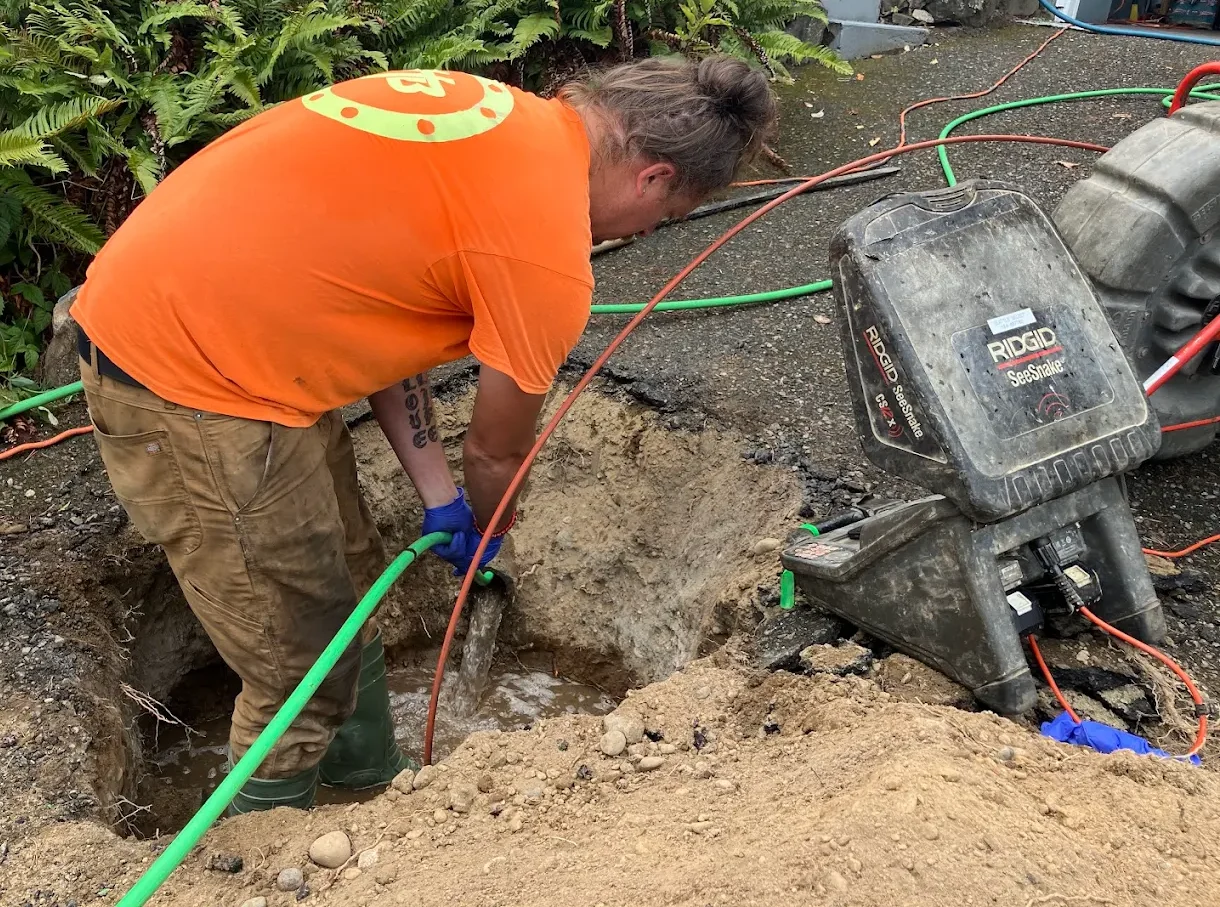
A sewer camera inspection runs a waterproof camera head through the lateral on a flexible rod, transmitting real-time footage to a monitor at the surface. In a single visit, the footage documents the pipe material, the condition of every joint in the run, any root intrusion located to a specific point, grease accumulation, belly sections, offset joints, and the structural integrity of the pipe wall throughout the lateral. No other diagnostic tool produces this information.
That footage is what separates a professional repair from an estimate-based one. A contractor who cameras before quoting knows exactly what the repair involves: the location and type of damage, the extent of affected pipe, the depth and access conditions, and which repair methods the pipe condition supports.
A contractor who quotes without a camera is estimating, and estimates on lateral work have a well-documented tendency to expand once the excavation reveals what was actually in the ground.
For Mercer Island homeowners, the camera run before any repair is not an optional add-on. It is the document that controls the entire project.
Distinguishing blockage from structural damage
One of the most valuable diagnostic distinctions professional camera inspection makes is between a blockage and a structural condition. Both produce similar surface symptoms: slow drains, gurgling, periodic backups. The repair for each is completely different.
A blockage from grease or debris clears with hydro jetting, restores full flow, and may not recur for years with appropriate maintenance. A structural condition such as a belly section, a collapsed pipe segment, or a severely offset joint does not clear with jetting. Applying a jetting service to a structural problem produces temporary flow restoration followed by the same symptoms within weeks, and the underlying structural condition continues to deteriorate during that interval.
A homeowner who has had the same clog cleared four times in two years has not had the same blockage four times. They have had a structural condition treated as a blockage four times, each time paying for a service that addressed the symptom while the actual problem advanced. Professional diagnosis ends that cycle with a single camera run.
Identifying conditions that would produce surprises during excavation
A pre-repair camera inspection also identifies conditions that would generate cost surprises if the repair goes to excavation without prior documentation:
- Pipe depth variations that require different equipment access than standard
- Sections where the lateral runs beneath a concrete driveway pad rather than open soil
- Areas where utilities or irrigation lines cross the lateral path
- Neighboring root systems that have extended further into the pipe run than the primary failure point
Each of these conditions affects the repair scope and cost. A professional who knows about them before mobilizing equipment can plan and price accordingly. A professional who discovers them after starting work has to replan mid-project, and the homeowner absorbs the difference.
How professional method selection avoids the most expensive repair mistakes
Once accurate diagnosis is in hand, the next benefit of professional sewer repair is correct method selection. Lateral repair in Mercer Island involves at least four meaningfully different methods, each appropriate for a specific range of conditions and each inappropriate for conditions outside that range. Choosing the wrong method does not just fail to fix the problem. It can actively worsen the pipe condition or make the correct repair more difficult to execute later.
Trenchless CIPP lining for intact-walled pipes
Trenchless CIPP lining inserts a resin-saturated liner into the existing pipe and cures it to form a new structural interior surface. The method requires only two small access pits, preserves the existing pipe alignment, and eliminates virtually all the restoration cost that traditional excavation generates.
For Mercer Island properties where landscaping, mature trees, stone driveways, and finished hardscape sit above many laterals, that restoration cost avoidance can run into the thousands.
The condition that makes a lateral a CIPP candidate is structural integrity: the pipe must be intact enough in its overall alignment and shape to support the liner during installation. A pipe with a severe belly, an extreme joint offset, or a collapsed section cannot be lined across that condition. Professional assessment from camera footage determines whether CIPP is on the table before any discussion of method or pricing.
Targeted spot repair for localized damage
A sewer pipe spot repair addresses a localized crack, joint offset, or small section of structural failure while leaving the surrounding pipe intact. It requires a smaller excavation footprint than a full lateral replacement and costs significantly less when the camera footage confirms that the failure is genuinely localized.
The professional benefit here is restraint. An unqualified contractor who encounters a lateral problem may default to full replacement as the lowest-risk option for themselves, regardless of whether the surrounding pipe warrants it. A professional contractor who cameras the lateral and finds a single damaged section in an otherwise sound pipe recommends and performs a spot repair. That recommendation protects the homeowner from paying for work that was not needed.
Full lateral replacement when the pipe has exceeded repair options
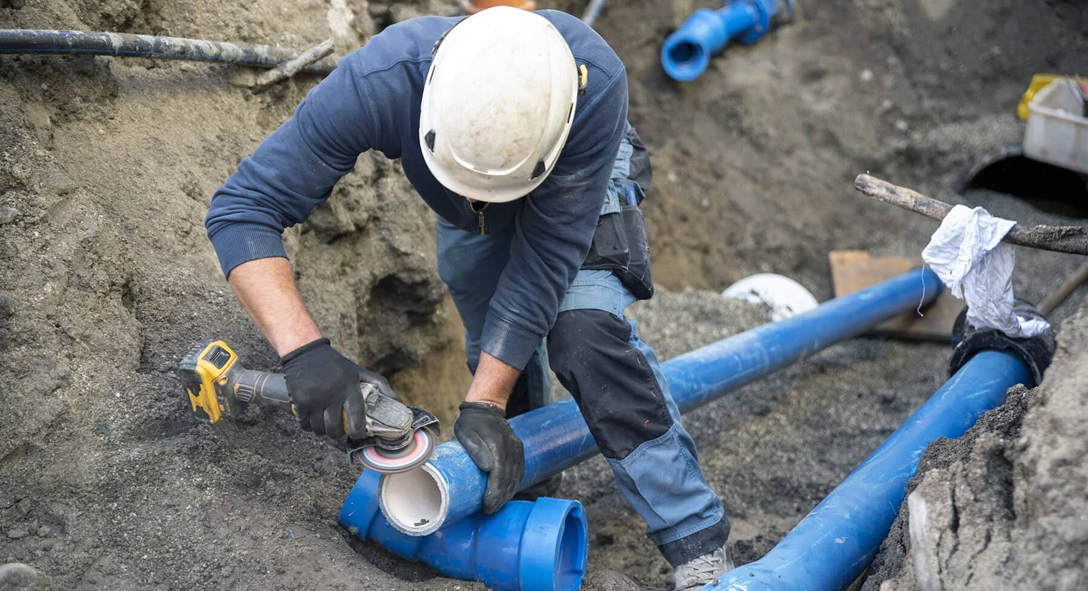
When camera footage shows a pipe that is too degraded for lining and too extensively damaged for targeted spot repair, full lateral replacement is the correct recommendation. In Mercer Island, this conversation most often arises with Orangeburg pipe from the 1940s and 1950s, which deforms from the inside as it ages and reaches a point where the bore is too distorted to support a liner and too uniformly affected for targeted repair.
The professional benefit in this scenario is timing. A homeowner who receives a full replacement recommendation supported by camera footage showing the pipe’s actual condition is in a very different position from one who receives the same recommendation without documentation.
The footage answers the question the homeowner will inevitably ask: is this replacement actually necessary, or is someone trying to sell me more work? Camera documentation turns that answer from an opinion into a recorded fact.
What professional repair does for Mercer Island property value
Mercer Island real estate commands a premium, and buyer due diligence in this market reflects that premium. Sewer lateral condition is increasingly a standard item in buyer inspections on the Eastside, and what those inspections find, or what the absence of documentation leaves unresolved, has a direct effect on transaction outcomes.
Professional sewer repair protects and supports Mercer Island property value in two distinct ways: through the quality of the repair itself, and through the documentation it produces.
Documented repairs remove a significant unknown from transactions
A Mercer Island homeowner who lists a property without any sewer documentation is offering a buyer an unknown. Buyers in this market have learned to treat that unknown as a liability, either requesting a seller-funded pre-listing scope or discounting their offer to account for the contingency. A seller who can present documented professional repair history, including camera footage before and after any work, removes that liability entirely.
The EPA WaterSense program estimates that household water leaks waste nearly 1 trillion gallons of water annually in the United States, and that finding and fixing leaks protects both households and water supply systems. The same principle applies to sewer lateral documentation: identifying and professionally repairing a condition before it surfaces in a transaction is categorically better than discovering it during one.
Mercer Island buyers who request a scope during due diligence and find a recently completed professional repair with documentation are in a very different position from those who find an undisclosed condition during the same inspection. The former closes; the latter negotiates.
How repair quality affects reinspection outcomes
A professional repair that is scoped post-completion produces footage showing the repaired condition. That footage is a durable record: the date, the scope of work, the before condition, and the after condition are all documented. If a buyer requests a scope during the transaction, that footage provides the context for interpreting what the buyer’s inspector finds.
A non-professional repair or a repair performed without pre- and post-camera documentation produces no equivalent record. If a buyer’s inspector finds a section of the lateral that was worked on and asks when and how it was repaired, the homeowner who used a professional has an answer. The homeowner who did not has a gap in the story that a sophisticated Mercer Island buyer will treat as a risk.
For a home sold at Mercer Island prices, the value differential between a documented lateral and an undocumented one is not marginal. Professional repair creates that documentation as a standard part of the process.
How professionals address root intrusion differently
Root intrusion is among the most common lateral problems in Mercer Island’s older neighborhoods, and it is also the problem most frequently addressed incorrectly by homeowners who call reactive service rather than professional contractors. The difference in approach produces dramatically different long-term outcomes.
The maintenance-versus-reactive distinction
Reactive root clearing addresses a blockage after it has become severe enough to affect drainage. A snake clears the root mass, flow is restored, and the homeowner assumes the problem has been handled. What has actually happened is that the root structure, still attached to the pipe wall at the entry point, begins re-establishing immediately. The recurrence timeline shortens with each cycle, because each clearing episode stimulates new growth response in the root system.
A professional approach to root intrusion starts with high-pressure jetting rather than snaking. Root intrusion clearing in Seattle-area homes scours the full interior circumference of the pipe, cutting root masses back to the wall rather than passing through the center of them. The recurrence timeline after jetting is meaningfully longer than after snaking because the pipe wall is cleaner and the re-establishment rate is lower.
More importantly, a professional approach follows the jetting with a camera confirmation. That post-jetting scope confirms that the clearing was complete and evaluates whether the pipe wall at the entry points shows structural damage that requires repair beyond the clearing service.
Homeowners across Mercer Island and nearby Bellevue who run this sequence on a maintenance schedule consistently find that the interval between service calls is longer and the repair costs when structural work is eventually needed are lower than for homeowners who respond reactively.
Scheduling to match root pressure rather than symptom recurrence
A professional contractor who cameras a lateral with root intrusion does not just clear the problem. They assess the severity of root pressure, the proximity of tree root systems to the pipe, and the structural condition of the joint at the entry point, and they recommend a clearing interval based on those findings rather than on when the next symptom appears.
For a Mercer Island lateral with moderate root intrusion from a mature tree within 15 feet of the pipe, an annual or biennial jetting schedule is appropriate maintenance. For a lateral with light root intrusion from trees that are 25 feet or more away, a three-year interval may be sufficient. That differentiation requires professional assessment. A homeowner working from symptom recurrence schedules maintenance too late by definition.
Root intrusion in Kirkland and Issaquah follows the same dynamics as in Mercer Island: tree proximity plus pipe age determines pressure rate, and professional assessment of that combination is the only way to build a maintenance schedule that actually prevents the next failure rather than responding to it.
Three questions that separate professional sewer contractors from the rest
The benefits of professional sewer repair only materialize when the contractor performing the work meets a meaningful standard. In King County, the sewer and drain service market includes operators ranging from highly qualified licensed contractors to individuals who own a snake and a truck. Three questions narrow the field quickly.
First: will you camera the lateral before quoting the repair and provide footage of both the pre-repair and post-repair condition? The answer should be yes without hesitation. A contractor who skips the camera passes the risk of misdiagnosis directly to the homeowner, and that risk is not acceptable at Mercer Island property values.
Second: are you licensed for sewer and plumbing work in Washington State, and will you pull the required permits for this repair? Professional contractors pull permits as a standard part of work that requires them. Contractors who suggest skipping permits expose the homeowner to liability for unpermitted work that surfaces in a future transaction.
Third: can you explain what the camera found, why you are recommending the specific method you are recommending, and what the alternatives are? A professional contractor explains findings and trade-offs in terms the homeowner can evaluate. A contractor who presents only one option without discussing alternatives either cannot assess the trade-offs or has a reason to steer toward a specific outcome.
The sewer inspection process for home buyers in Seattle establishes the same due diligence standard: verifying credentials and confirming a camera-first workflow is basic risk management for a repair affecting one of the highest-value components of a high-value property. Preventative sewer maintenance and professional repair both deserve this same transparent professional standard.
Conclusion
Professional sewer repair in Mercer Island delivers a specific and measurable set of benefits: accurate camera-based diagnosis that eliminates guesswork, correct method selection that matches repair scope to actual pipe condition, repair quality that produces durable outcomes rather than temporary symptom relief, and documentation that supports one of the most active and sophisticated real estate markets in the region.
The alternative, reactive or under-qualified repair, produces the opposite outcomes. Symptoms recur. Repairs are performed against conditions that were never accurately characterized. Documentation gaps surface at the worst possible moment in a transaction. And the costs of getting it wrong, in Mercer Island, are commensurate with the property values involved.
When you are ready to bring professional sewer service to your Mercer Island lateral, Seattle Select Sewers is ready to help.