When a sewer line fails, most homeowners picture the worst version of the repair: a backhoe in the front yard, a trench running from the house to the street, torn-up landscaping, a cracked driveway, and a project that takes a week or more to complete. That used to be the only option. It is not anymore. Understanding the trenchless sewer repair advantages in Mountlake Terrace gives homeowners a faster, less disruptive, and often more cost-effective path to a permanent fix.
Mountlake Terrace was incorporated in 1954, and the residential development that followed through the 1960s and 1970s defined the neighborhoods that exist today. According to the City of Mountlake Terrace Sewer Division, the city’s sanitary sewer system was built to connect those growing neighborhoods to the treatment plant in Edmonds, and it now includes over 70 miles of gravity sewer main across the city. Much of that infrastructure was installed during the original buildout, which means the pipes under many Mountlake Terrace homes are now 50 to 70 years old and showing their age.
Trenchless sewer repair was developed specifically for situations like this, where aging pipes need to be repaired or replaced without tearing apart the property above them. For homeowners in a city full of established lots, mature landscaping, and mid-century homes with driveways and walkways directly over the sewer line, trenchless methods offer a way to restore a failing pipe with a fraction of the disruption that traditional excavation requires.
In this article, you will learn about:
- Why Mountlake Terrace homes need sewer repair solutions now
- What trenchless sewer repair is and how it works
- Advantages of trenchless repair over traditional excavation
- What the trenchless repair process looks like step by step
- When trenchless repair is not enough
- How to get started with trenchless repair in Mountlake Terrace
Keep reading to find out how trenchless technology can save your property from unnecessary destruction while giving your sewer line decades of new life.
Why Mountlake Terrace homes need sewer repair solutions now
The sewer lines beneath most Mountlake Terrace homes were never designed to last forever, and many of them are now operating well past their intended lifespan. The question is not whether repairs will be needed, but when and how.
Mid-century infrastructure reaching the end of its life
The City of Mountlake Terrace has acknowledged that the city’s utility infrastructure was installed mostly in the 1960s and 1970s, and that those pipes are now failing. The city is actively planning a comprehensive water and sewer plan with a 20- to 50-year outlook to address the challenge. For individual homeowners, this means that the side sewer running from your house to the city main is likely the same pipe that was buried when the home was built, and it may be approaching or past the point where problems are inevitable.
Homes in neighborhoods around Lake Ballinger, along 56th Avenue, and throughout the original residential grid all share this timeline. Even if a home has been updated on the surface, the underground sewer lateral is often original and untouched.
Common pipe materials in Mountlake Terrace and how they fail
The sewer laterals under mid-century Mountlake Terrace homes were typically built using one of three materials:
- Cast iron, which corrodes from the inside over decades. Rust scale narrows the pipe, traps debris, and eventually weakens the walls to the point of cracking or collapse.
- Concrete, which erodes internally as the cement surface wears down, creating a rough interior that catches waste and compromises structural integrity.
- Orangeburg (bituminous fiber pipe), a tar-paper material used because it was inexpensive. Orangeburg deteriorates faster than any other common pipe material and often collapses entirely within 30 to 50 years.
Each of these materials has a finite lifespan, and the homes built during Mountlake Terrace’s original development era are now at or beyond the typical failure window for all three.
The cost of waiting too long
A sewer line that is quietly deteriorating underground does not get better on its own. Cracks widen, roots expand, corrosion deepens, and the margin between a functioning pipe and a sewer backup shrinks. Waiting until the line fails completely usually means:
- Emergency repair costs that are significantly higher than planned work
- Property damage from a backup that could have been avoided
- A more invasive repair because the pipe has collapsed and trenchless methods may no longer be an option
- Restoration costs for landscaping, driveways, and hardscaping that were destroyed during an emergency dig
Addressing a failing sewer line proactively, while trenchless repair is still a viable option, is almost always less expensive and less disruptive than waiting for a catastrophic failure.
What trenchless sewer repair is and how it works
Trenchless sewer repair is a category of methods that fix or replace a damaged pipe from the inside, without digging a trench from the house to the street. The two most common trenchless approaches for residential sewer lines are CIPP lining and pipe bursting.
Cure-in-place pipe lining
CIPP lining is the most widely used trenchless method for residential sewer repair. A flexible tube saturated with resin is inserted into the existing pipe through an access point, such as a cleanout or a small excavation at one end of the line. The liner is inflated to press against the interior walls of the host pipe, then cured using heat, steam, or UV light until the resin hardens into a rigid, seamless new pipe inside the old one.
According to NASSCO, the National Association of Sewer Service Companies, a properly designed, installed, and tested CIPP liner has a minimum life expectancy of 50 years. The finished liner is smooth and jointless, which eliminates the entry points that roots use to get inside and reduces friction that slows flow. CIPP works across all common host pipe materials, including cast iron, clay, concrete, and Orangeburg, as long as the pipe has not fully collapsed.
Pipe bursting for full replacement
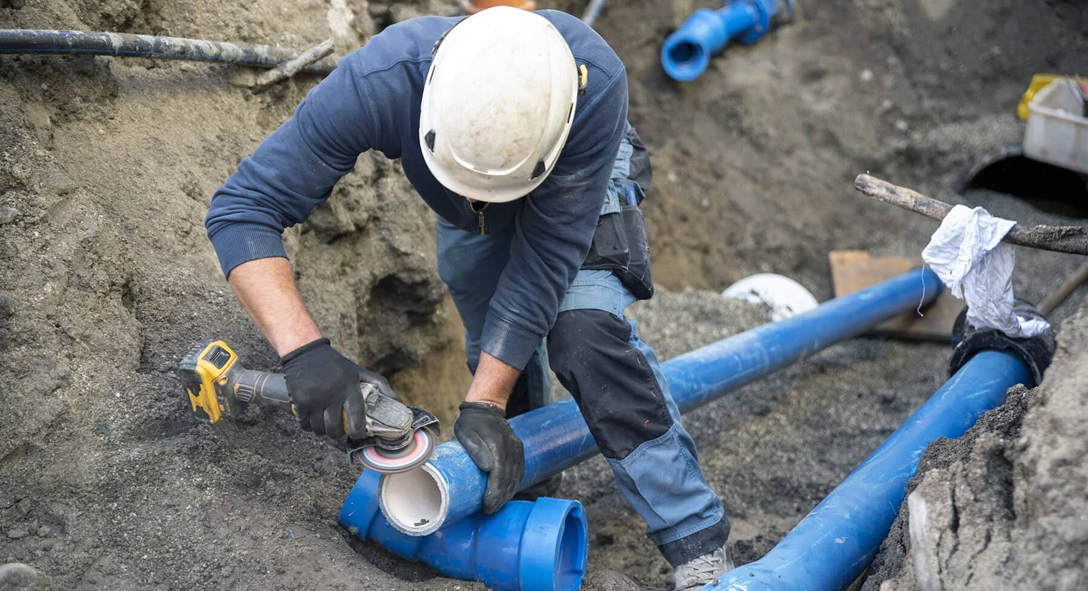
When a pipe is too damaged for lining but the homeowner still wants to avoid a full open-cut excavation, pipe bursting offers an alternative. A cone-shaped bursting head is pulled through the old pipe, fracturing it outward into the surrounding soil while simultaneously dragging a new HDPE pipe into place behind it. The result is a completely new pipe installed along the same path as the old one.
Pipe bursting requires small access pits at each end of the run rather than a continuous trench. It is a good option for pipes that have collapsed in sections, are severely deformed, or are too deteriorated for a liner to bond properly.
When trenchless methods are the right fit
Trenchless repair is well suited for the majority of residential sewer problems, but it is not a universal solution. It works best when:
- The pipe is cracked, corroded, or root-invaded but still maintains its general shape and alignment
- The damage involves joints, fractures, or erosion rather than a total collapse
- The homeowner wants to preserve landscaping, driveways, walkways, or other surface features
- The line is accessible through a cleanout or can be accessed with minimal excavation at the entry point
A camera inspection is the essential first step. It shows the contractor exactly what condition the pipe is in and whether a trenchless approach will work for the specific situation.
Advantages of trenchless repair over traditional excavation
Trenchless repair exists because traditional excavation, while effective, comes with significant collateral costs that often exceed the repair itself. For homeowners in Mountlake Terrace, where established properties have mature trees, concrete driveways, and decades of landscaping, those collateral costs matter.
Your yard, driveway, and landscaping stay intact
This is the advantage most homeowners care about first. A traditional sewer line replacement requires a trench from the house to the street, which means everything in the path gets removed: grass, garden beds, shrubs, walkways, a section of driveway, and sometimes portions of the sidewalk or street. After the pipe is replaced, all of that has to be restored.
Trenchless repair avoids nearly all of that destruction. CIPP lining is installed through existing access points. Pipe bursting requires small pits at each end of the run. The surface between those points stays untouched. For a Mountlake Terrace homeowner with a landscaped front yard and a concrete driveway running directly over the sewer line, that difference can save thousands of dollars in restoration alone.
Faster project timelines
A traditional excavation and replacement typically takes several days to a week or more, depending on the length of the line, the depth of the pipe, soil conditions, and the amount of surface restoration required. Trenchless repairs are substantially faster:
- CIPP lining for a typical residential lateral can often be completed in a single day.
- Pipe bursting usually takes one to two days, including the small access excavations.
- Surface restoration after a trenchless repair is minimal or unnecessary, eliminating the days or weeks of follow-up work that traditional excavation requires.
Shorter timelines mean less disruption to your daily routine, fewer days with restricted access to your driveway, and a faster return to normal.
A new pipe built to last decades
Trenchless repair does not just patch the problem. CIPP lining creates a structural, seamless pipe inside the old one that performs like a new installation. The smooth, jointless interior resists root intrusion, reduces debris accumulation, and improves flow compared to the original pipe. NASSCO documents a minimum 50-year design life for properly installed CIPP liners, and the technology has been in use since the 1970s, with early installations still performing today.
Pipe bursting goes a step further by installing an entirely new HDPE pipe, a material that is fused at every connection and highly resistant to corrosion, root intrusion, and ground movement. Either method gives the homeowner a sewer line that should outlast the next several decades of ownership.
Lower total cost when restoration is factored in
The upfront cost of a trenchless repair can be comparable to or slightly higher than the pipe-laying portion of a traditional excavation. But when you add up the full cost of traditional replacement, including excavation, backfill, compaction, driveway repair, sidewalk repair, landscaping restoration, and potential permit fees for street work, trenchless methods frequently come out ahead.
For properties where the sewer line runs under a driveway, a patio, a retaining wall, or mature landscaping, the restoration costs after excavation can rival or exceed the cost of the pipe work itself. Trenchless repair avoids those costs entirely.
What the trenchless repair process looks like step by step
The process is straightforward and typically follows the same sequence from initial inspection to final verification.
Camera inspection to assess the pipe
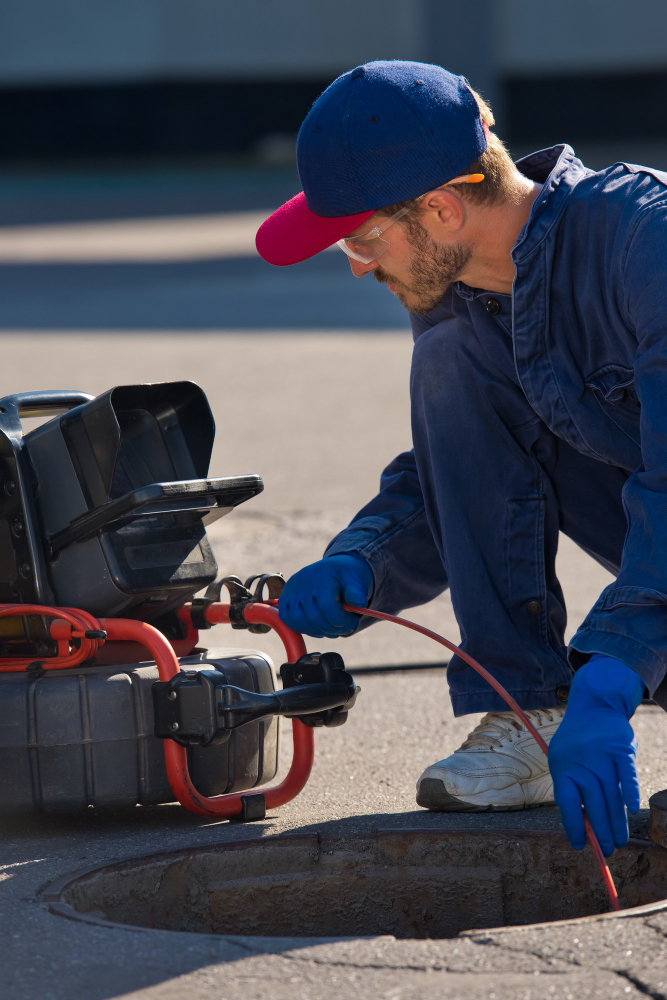
Every trenchless project starts with a sewer camera inspection. A high-definition camera is fed through the line to document the interior condition of the pipe. The footage shows the contractor exactly where the damage is, what type of damage exists, and whether the pipe is a candidate for lining, bursting, or needs a different approach. This step eliminates guesswork and ensures the repair method matches the actual condition.
Cleaning the line before repair
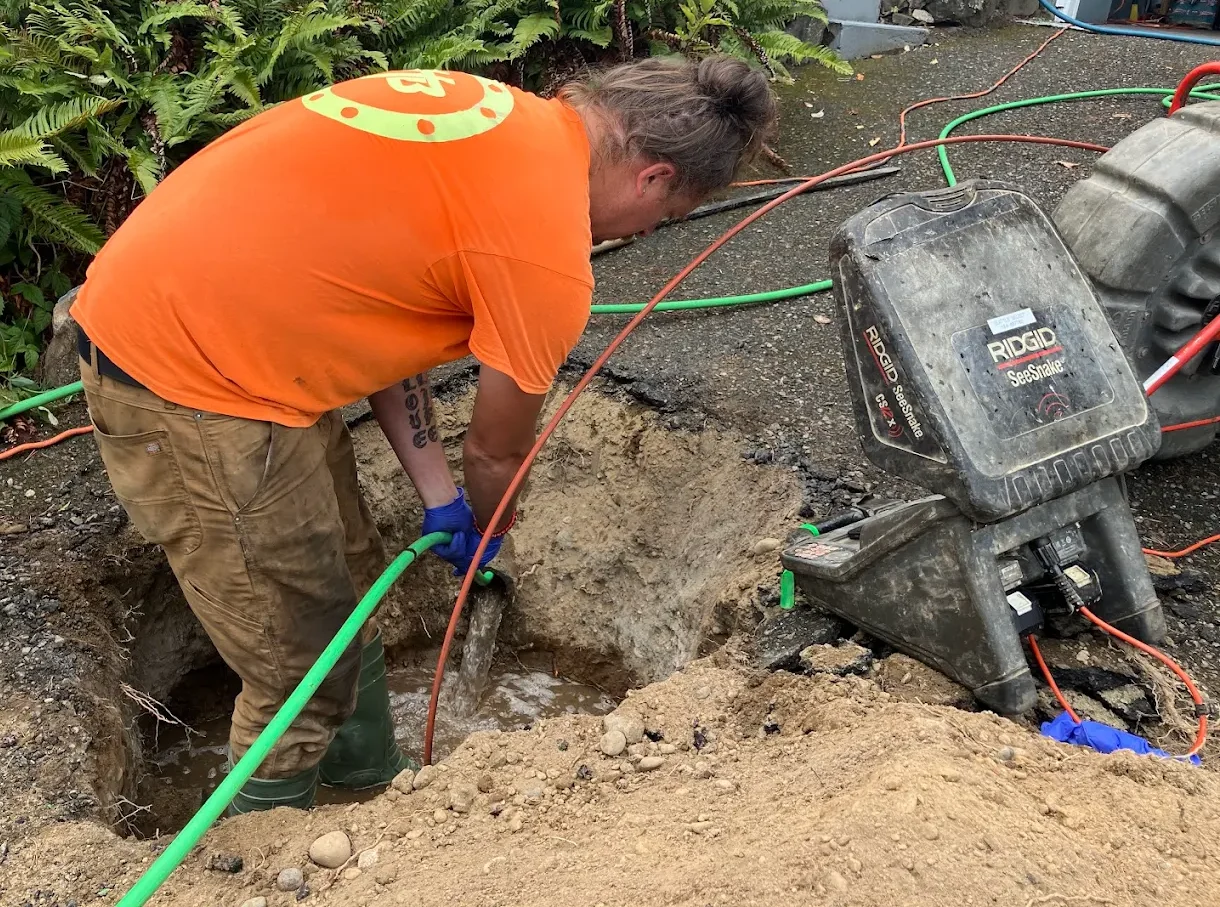
Before a liner can be installed, the pipe interior must be clean. Hydro jetting scours the pipe walls with high-pressure water, removing roots, grease, scale, and debris. The goal is a clean surface that the liner can bond to uniformly. For pipes with heavy root intrusion, mechanical cutting tools may also be used before jetting.
Liner installation and curing
Once the pipe is clean and the camera confirms it is ready, the resin-saturated liner is inserted through the access point and positioned inside the host pipe. The liner is inflated to press against the pipe walls, conforming to the shape of the interior. Heat, steam, or UV light is then applied to cure the resin, hardening it into a rigid structural pipe. The curing process typically takes a few hours, and the line can be returned to service shortly after.
Final inspection and verification
After the liner has cured, a second camera pass confirms that the installation is complete and the new pipe surface is smooth, continuous, and free of defects. The contractor provides recorded footage of the finished liner, giving the homeowner documentation of the work for their records and for any future real estate transactions.
When trenchless repair is not enough
Trenchless technology handles the vast majority of residential sewer problems, but there are situations where it cannot do the job.
Fully collapsed pipes
CIPP lining requires the host pipe to maintain its general round shape so the liner can inflate and bond properly. If the pipe has collapsed, meaning the walls have caved inward and the interior passage is crushed, a liner cannot be installed. Pipe bursting may still be an option in some cases, but a full collapse sometimes requires traditional excavation to remove the failed pipe and install a new one.
Severe misalignment or bellies
A pipe with a significant belly, where a section has sagged and lost its downward slope, may not be fixable with a liner. The liner conforms to the existing pipe shape, so it would follow the sag rather than correct it. Severe offset joints where pipe segments have shifted several inches apart also fall outside what a liner can address.
When traditional excavation is the better option
In cases of complete collapse, extreme misalignment, or damage so severe that the pipe cannot hold a liner, a traditional sewer line replacement is the right call. A spot repair may also be an option when the damage is confined to a single section and the rest of the line is in good condition. The camera inspection determines which approach fits the situation, and a qualified sewer contractor should present the options honestly rather than default to the most expensive one.
How to get started with trenchless repair in Mountlake Terrace
If your home was built during Mountlake Terrace’s mid-century development period and the sewer line has never been inspected or replaced, taking the first step is simpler than most homeowners expect.
Schedule a sewer camera inspection
The inspection is the starting point for every decision that follows. It shows you the actual condition of your pipe and tells you whether repair is needed now, can wait, or is urgent. If the pipe is sound, you get peace of mind and a baseline for future comparisons. If problems exist, you catch them early enough to use trenchless methods rather than waiting until excavation is the only option.
Understand your options before committing
A reputable sewer contractor will show you the camera footage, explain what each defect means, and present the options that fit your pipe’s specific condition. Those options might include:
- CIPP lining for a pipe with cracks, joint issues, or root entry across its length
- A spot repair for an isolated defect in an otherwise sound line
- Pipe bursting for a line that is too deteriorated for lining
- Traditional excavation for a collapsed section
You should never feel pressured into a decision on the spot. Ask for the inspection video, take the written estimate home, and compare if you want a second opinion.
Questions to ask your sewer contractor
Before hiring anyone for trenchless work, ask:
- Can I see the camera footage before and after the repair?
- What type of liner do you use, and what warranty does it carry?
- Are your technicians trained and certified for CIPP installation?
- What happens if the liner does not bond properly or a defect is found during the final camera pass?
- Do you handle the permits, or is that my responsibility?
The answers tell you whether you are working with a specialist who does this work every day or a generalist who offers it as a side service.
Conclusion
Trenchless sewer repair exists because homeowners should not have to sacrifice their yard, their driveway, and a week of their lives to fix a pipe they cannot even see. For Mountlake Terrace homes built on mid-century infrastructure that is now 50 to 70 years old, trenchless methods offer a permanent solution that works with the property instead of against it.
If you are noticing slow drains, recurring backups, sewer odors, or any of the other signs that a pipe is failing, the smartest move is to find out what is happening underground before the pipe decides for you. A single camera inspection answers the question and opens the door to a repair that protects both your home and the property around it.
Seattle Select Sewers specializes in trenchless sewer repair across the greater Seattle area, including Mountlake Terrace and the surrounding communities. Their team can scope your line, show you exactly what condition it is in, and recommend the right approach, whether that is lining, bursting, a spot repair, or something else entirely. Reach out to schedule an inspection and see what trenchless technology can do for your home.