Sewer problems are expensive, inconvenient, and stressful, which is exactly why so much bad advice has built up around them over the years. A neighbor swears chemical drain cleaner fixed everything. A quick online search tells you that trenchless repair costs twice as much as digging.
Your brother-in-law insists that as long as water is draining, nothing is wrong. In Bellevue, where older neighborhoods sit alongside newer developments and tree-lined streets run root systems deep into lateral lines, these common sewer repair myths cause real, costly damage every season.
The problem is that acting on the wrong information tends to delay the call that would have kept a $500 snaking job from turning into a $12,000 excavation. According to the American Society of Civil Engineers, sewer and wastewater pipes in the ground average 45 years old nationwide, and some components are more than a century old. In a city like Bellevue, where many neighborhoods were built out in the 1960s and 1970s, that statistic describes the pipes running under your yard right now.
This article separates the myths from the facts so you can make clear-headed decisions the next time something backs up, slows down, or smells wrong. You will find out why the cheapest-looking quote is almost never the cheapest fix, why slow drains are never just a slow drain, and why skipping the camera inspection is one of the most expensive things a homeowner can do.
In this article, you will learn about:
- Why slow drains are never just a minor inconvenience
- The truth about chemical drain cleaners and sewer lines
- What trenchless repair actually costs versus traditional excavation
- Why a camera inspection is not optional
- The myth that sewer problems always announce themselves clearly
Keep reading to understand which beliefs are quietly costing Bellevue homeowners thousands of dollars.
Slow drains are never just a minor inconvenience
The most common dismissal in sewer repair is also the most dangerous: “it drains slow, but it still drains.” Homeowners hold onto that logic right up until the moment a floor drain backs up or wastewater starts coming up through the bathtub. By that point, a manageable cleaning job has become an emergency call, and emergency calls come with emergency pricing.
A slow drain is a symptom, not a condition. It tells you something is building up, restricting, or partially blocking flow somewhere in the line. What you do not know, until a sewer camera inspection confirms it, is whether that something is a grease deposit near the trap or tree roots 40 feet down the main line. Treating those two problems the same way produces very different results.
One slow drain versus many slow drains
A single slow drain is often localized. Hair in a bathroom trap, a grease deposit in a kitchen line, or soap buildup near a fixture can all throttle drainage in one spot without touching the rest of the system. These are real problems, but they are contained ones, and a power snaking service or targeted drain cleaning usually resolves them quickly.
Multiple slow drains are a different story. When the kitchen sink, the downstairs tub, and the washing machine drain all slow down around the same time, the restriction is almost certainly in the main sewer line rather than in any individual branch. That is a main sewer line repair conversation, not a trap-cleaning conversation.
Signs that push a single slow drain toward a main-line concern include:
- Gurgling sounds from a drain or toilet when another fixture runs
- Water backing up into the tub when the washing machine drains
- Sewage odors coming from floor drains or cleanouts
- A toilet that bubbles or rises briefly when you flush another one
None of these are subtle once they start. The problem is that homeowners often explain them away for weeks or months before calling.
Why tree roots accelerate the problem in Bellevue
Bellevue’s mature tree cover is beautiful and relentless. Root systems from maples, cedars, and ornamental trees follow moisture gradients directly toward lateral sewer lines, and older clay or Orangeburg pipe sections offer almost no resistance. The roots enter through joints and cracks, then fan out inside the pipe, catching debris and tightening the restriction with every passing week.
A sewer backup in Bellevue that starts as one gurgling drain can become a full blockage within a single season once root mass reaches a critical density. Waiting for slow drains to become a backup is not a conservative approach. It is just a more expensive version of the same repair.
The cost of waiting
The repair bill for a slow drain caught early looks very different from the bill for a sewage backup caught late. Hydro jetting before a full blockage forms costs a fraction of emergency excavation after one does. Time is the variable homeowners control, and most of them give it up without realizing it.
The truth about chemical drain cleaners and sewer lines
Walk into any hardware store in Bellevue and you will find a shelf of products promising to dissolve clogs, clean pipes, and restore full flow. The labels are confident. The reality is considerably less impressive, and for sewer lines specifically, these products range from useless to genuinely harmful.
Chemical drain cleaners are formulated to break down organic material at or near the drain opening. They can dissolve hair and soap scum in a bathroom trap. They cannot reach a root ball 30 feet down a lateral, fix a cracked pipe, clear a collapsed section, or remove compacted grease from a cast iron main.
More to the point, the caustic compounds in these products, typically sodium hydroxide or sulfuric acid, degrade older pipe materials over time. PVC joints soften with repeated exposure, and cast iron corrodes faster when it is regularly bathed in acid.
What chemical cleaners can and cannot do
Here is an honest breakdown of where these products land:
- Minor organic clogs at a drain opening: sometimes effective as a short-term measure
- Grease buildup in kitchen drain branches: very limited; grease re-solidifies quickly
- Root intrusion at any depth: no effect whatsoever
- Cracked, offset, or collapsed pipe sections: no effect
- Heavy debris accumulation in a main line: no effect
The problem is not just that these products fail on serious problems. It is that they give homeowners the illusion of resolution. The drain clears temporarily, and the underlying condition continues developing untouched. By the time a slow drain becomes a full backup, the homeowner has spent money on products that did nothing and lost the window for a cheaper fix.
The sewer line damage you cannot see from above
Sewer lines in Bellevue neighborhoods built in the 1960s and 1970s are frequently made from clay tile or Orangeburg pipe, materials with known failure modes that chemical drain cleaners interact with poorly. Clay joints separate over decades of soil movement. Orangeburg, a pressed fiber product installed heavily after World War II, softens and collapses from inside as it ages and absorbs moisture.
Neither problem shows up on the surface until significant damage has occurred. A sewer line inspection is the only tool that tells you what you are actually dealing with. Pouring chemicals into an Orangeburg pipe that has already begun to deform accomplishes nothing except postponing the conversation you will eventually have to have.
When the smell comes back
One of the clearest signals that a chemical cleaner has not actually solved a problem is odor recurrence. Sewage odors that return within days of treating a drain point to a deeper issue: a broken seal, a root intrusion trapping debris, a partially collapsed section creating a pooling zone, or a dry P-trap opening a direct path back from the sewer.
A sewer odor diagnosis is a different job from a drain cleaning, and conflating the two costs time and money.
What trenchless repair actually costs versus traditional excavation
The myth that trenchless sewer repair is significantly more expensive than traditional excavation is one of the most persistent and financially damaging beliefs a homeowner can carry. It leads people to dismiss trenchless methods as a premium option for people who care too much about their lawn, rather than treating it as a cost comparison they should actually run.
The comparison is more nuanced than either “trenchless costs more” or “trenchless costs less.” What is consistently true is that the full-project cost of traditional excavation is almost always higher than the line-item repair quote, once you account for what comes after the pipe work is done.
What excavation quotes leave out
A traditional excavation quote typically covers labor, equipment, and the replacement pipe. It almost never covers restoration. Repairing a driveway trench, replacing sod, re-planting landscaping, and patching concrete or pavers adds a documented $3,000 to $8,000 on top of base repair pricing, according to industry cost data on sewer line repair methods.
In Bellevue, where landscaped yards and hardscape driveways are common, that restoration cost regularly sits at the high end of that range.
Trenchless methods, including CIPP lining and pipe bursting, require only two small access pits, so restoration costs are minimal or zero. The base repair price may be comparable to or slightly higher than excavation for the same pipe run, but the total out-of-pocket cost after you factor in driveway and landscaping restoration typically favors trenchless by a significant margin.
When traditional excavation is actually the right call
Trenchless methods have real limits. A pipe that has completely collapsed cannot be lined; there is nothing left to support the liner sleeve. Severely offset joints or sections with major soil intrusion may require excavation to access directly. And shallow, easily accessible pipes on properties with minimal landscaping can sometimes be handled more efficiently through traditional methods.
The point is not that trenchless is always better. It is that the comparison should be made on full project cost, including restoration, not on the base labor quote alone. Homeowners who skip that comparison regularly end up paying thousands more than they needed to.
The sewer repair decision framework
Before committing to either method, the sequence that protects homeowners looks like this:
- Schedule a camera inspection to see the actual condition of the pipe
- Get the damage characterized: location, severity, pipe material, pipe depth
- Request quotes for both trenchless and traditional methods, including restoration costs
- Compare full project cost, not just the repair line item
- Confirm permit requirements with your contractor before work begins
This process works in Bellevue just as it does in Redmond or anywhere else in the Eastside. The method that costs less on paper rarely costs less when the full accounting is done.
Why a camera inspection is not optional
One of the most consequential myths in sewer repair is that a camera inspection is an upsell, an optional add-on that a contractor recommends to pad a bill. In reality, any contractor who quotes repair or replacement work without first running a camera is guessing, and you are signing a contract based on that guess.
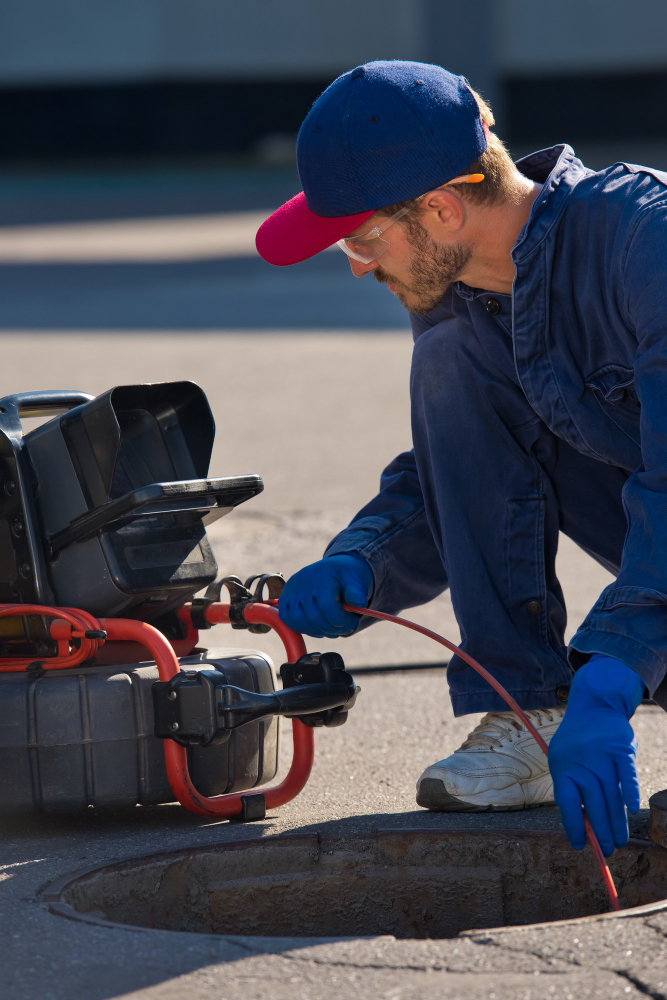
A sewer camera inspection is the only diagnostic tool that tells you what is actually wrong with a line. It identifies the location of the problem, the type of damage, the extent of the damage, and the pipe material and condition on either side of the problem area. Without it, a contractor is estimating based on symptoms, age, and probability, and those estimates have a tendency to expand once the excavator is already in your yard.
What a scope reveals that symptoms cannot
Physical symptoms tell you a problem exists somewhere in the system. A scope tells you where, what, and how bad. The difference matters enormously for the repair decision:
- Root intrusion at a specific joint calls for targeted hydro jetting or a spot CIPP repair
- A belly in the pipe, where a low section pools water, may require excavation at that specific location
- Multiple cracks along a long run may indicate the entire lateral needs replacement
- A localized offset joint 20 feet from the house is a completely different job from a collapsed section 60 feet out
Each of these conditions calls for a different repair strategy and carries a different price tag. Without a scope, a contractor cannot tell you which one you have. A homeowner who accepts a quote without a camera inspection ahead of it is authorizing work against an unknown problem, and the scope of that work can change significantly once the pipe is actually visible.
The home-sale case for a camera inspection
Sewer inspections for home buyers in the Bellevue market have become standard practice in recent years, and for good reason. A sewer scope is not included in a standard home inspection, and older Eastside homes carry meaningful sewer risk that a visual walkthrough will never surface. The Environmental Protection Agency estimates that publicly-owned sewer systems account for approximately 724,000 miles of sewer pipe nationally, and a significant portion of the residential laterals feeding into those systems was installed decades ago with materials that are now failing.
Buyers who skip the scope inherit whatever problems exist in that lateral. Sellers who complete a pre-listing inspection avoid the repair negotiation entirely, or fix the problem before it surfaces at the worst possible moment.
The cost of running a camera versus the cost of not running one
A camera inspection for a standard residential lateral in the Bellevue area typically runs $150 to $300. The repair a proper diagnosis enables, a targeted $2,400 spot repair rather than a $6,200 full-line replacement, produces savings that dwarf the cost of the inspection many times over. This is not a hypothetical. It is a pattern that plays out regularly when homeowners compare scoped quotes against unscoped ones.
The myth that sewer problems always announce themselves clearly
There is a widely held belief that sewer problems are loud, obvious, and impossible to miss. The image is a dramatic one: sewage in the yard, a backed-up basement, water pouring from somewhere it should not be. The reality is that many serious sewer problems develop slowly, quietly, and entirely out of sight, which is exactly what makes them expensive by the time they announce themselves.
This myth keeps homeowners from scheduling preventative maintenance, from getting scopes on older properties, and from acting on minor symptoms early. It is the belief that lets a root intrusion in a clay joint grow from a hairline entry point to a nearly blocked line over two or three years without triggering any alarm.
The hidden failure modes
Several of the most serious sewer conditions produce minimal surface symptoms until they reach a critical stage:
- Bellied pipe: a low section fills with water and debris, creating a slow-developing blockage. No visible surface symptom until backup occurs.
- Partial root intrusion: roots enter at a joint and grow inward slowly, reducing flow gradually over months. The homeowner notices a slow drain and attributes it to something routine.
- Settling pipe with offset joints: seasonal soil movement shifts pipe sections out of alignment. Flow continues but debris catches at the offset and builds up over time.
- Pinhole leaks in older clay or Orangeburg sections: wastewater seeps into surrounding soil without backing up into the structure. The first symptom homeowners often notice is an unusually green patch of lawn or soft, wet ground near the line.
None of these conditions produce the dramatic symptoms the myth predicts. All of them are expensive if they progress to failure before they are addressed.
Why Bellevue homes carry specific hidden risk
Bellevue’s development history creates a cluster of properties with lateral lines in the 50-to-60-year age range, roughly the window where clay tile and Orangeburg pipe start failing at a higher rate.
The Congressional Budget Office notes that the average useful life of a sewer line is estimated at 50 years, while many sewer mains were installed shortly after World War II, meaning a large share of residential laterals connected to those systems are at or past that threshold. Clay and Orangeburg pipe sit at the shorter end of the lifespan range.
A home built in 1968 in Bellevue very likely still has its original lateral. That lateral has been carrying wastewater for more than 50 years, through decades of root pressure, soil movement, and freeze-thaw cycling. Waiting for it to announce its own failure is a significant financial gamble. Preventative sewer maintenance and periodic inspection for hidden sewer issues are how smart homeowners manage that risk rather than absorbing it all at once.
What proactive inspection actually catches
The EPA estimated that as of 2024, $630 billion in wastewater infrastructure investment was needed to repair and replace deteriorating systems across the country, a figure that reflects just how far behind residential and municipal sewer infrastructure has fallen. The privately-owned laterals running from homes to the public main are the sole financial responsibility of the homeowner, making proactive inspection the most straightforward risk management available.
A periodic scope on a home older than 30 years catches conditions like root intrusion, belly formation, and joint offsets while they are still in the category of manageable repairs rather than emergency replacements.
The gap between a $600 hydro jetting service and a $10,000 full lateral replacement is almost always filled with time, specifically the time homeowners spent waiting for a problem to announce itself loudly enough to demand action.
Properties in Kirkland, Issaquah, and Mercer Island face the same risk profile as Bellevue. Lateral age, tree cover, and soil conditions are consistent across the Eastside, and the same preventative logic applies throughout.
Conclusion
Sewer repair myths do not just spread misinformation. They delay decisions, inflate repair costs, and turn manageable problems into emergencies. The homeowners who avoid the most expensive outcomes in Bellevue are not the ones who happened to get lucky.
They are the ones who got a scope before they needed one, compared full project costs rather than line-item quotes, and called a professional when a slow drain was still a slow drain rather than waiting for a backup to make the decision for them.
The pipe under your yard is aging on its own schedule. The myths above give you no useful protection against that reality. What does protect you is accurate information, a camera inspection when you need one, and a sewer contractor you can trust to tell you what is actually in that line.
When you are ready to get a clear picture of what your sewer lateral is actually doing, Seattle Select Sewers is ready to help.